
Hilo by Spribe is a quick card-prediction game built around a simple question: will the next card be higher or lower than the one currently shown? Its rules are easy to grasp, but each choice brings a fresh risk decision. That makes Hilo suitable for short sessions as well as tournament-style play, where players compete under a shared format rather than simply judging a session by one lucky round.
This review focuses on how Hilo works, what bracket-style tournaments can mean for players, and what to check before joining a casino game. Tournament rules are not necessarily identical across casinos: entry fees, scoring, schedules, prizes, and tie-breakers may vary. Read the specific event terms before wagering, and treat any example below as an explanation of format—not a promise of results.
How Hilo works
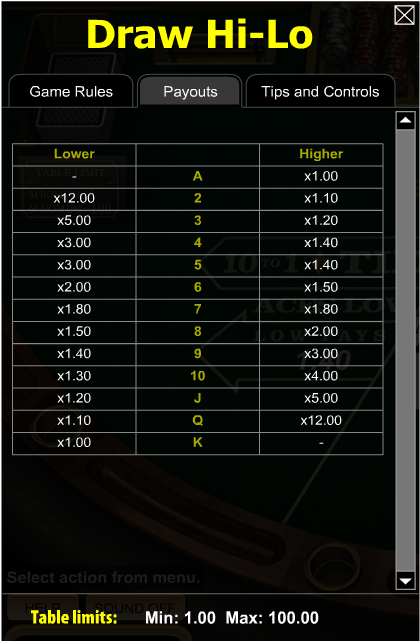
A round begins with a face-up card. The player predicts whether the next card will be higher or lower. If the prediction is correct, the player may usually continue and make another prediction, increasing the potential payout as the sequence grows. A wrong call ends the streak and can cost the stake or the accumulated amount, depending on the game’s rules and the selected cash-out options.
Some card values make a prediction less straightforward than others. A card near the middle of the rank range leaves plausible outcomes in both directions, while a very high or low card may make one direction look more attractive. Suits generally do not determine whether a card is higher or lower, but players should check the game’s on-screen rules for its exact ranking and any special treatment of equal cards.
Hilo is a game of chance. Previous cards do not make a future result certain, and a run of correct calls does not guarantee that the next one will also be correct. The interface may present a history of outcomes, but that record should not be mistaken for a reliable prediction tool.
What tournament and bracket formats add
A tournament places results in a competitive context. Instead of focusing only on an individual round’s payout, participants may be ranked by a defined measure such as points, total winnings, or a score accumulated during a limited period. In a bracket-style event, players or scores advance through successive stages until a final round determines the winner or prize positions.
The exact structure depends on the casino hosting the event. A “bracket” might mean direct head-to-head matches, or it might describe a leaderboard divided into qualifying stages. Some events may use fixed starting balances or a set number of rounds; others may count results during a time window. Do not assume that two tournaments using similar labels follow the same rules.
Questions to check before entering
- How is the score calculated? Confirm whether ranking is based on points, profit, multipliers, or another measure.
- What advances a player? Check the number of qualifying places and whether ties are resolved by a stated rule.
- Is the entry fee refundable? Determine whether the buy-in is separate from gameplay funds and whether it can be returned if the event is cancelled.
- What are the prize terms? Review prize distribution, eligible countries, withdrawal requirements, and any expiration date.
- When does the clock start and stop? Tournament windows can be short, so confirm the time zone and deadline.
In a knockout bracket, a single poor result might eliminate a participant. A leaderboard tournament may allow more attempts or compare scores across a larger field. Each format rewards a different kind of consistency, but neither changes the underlying uncertainty of card outcomes. A tournament can make play feel more urgent; it does not make a prediction more likely to be correct.
Playing Hilo strategically, without chasing certainty
A sensible approach begins with a fixed budget and a clear session limit. Decide in advance how much you are prepared to lose, and do not raise that limit to recover a bad streak or qualify for a prize. If the tournament requires a particular pace, calculate whether you can participate comfortably within the stated rules rather than increasing stakes impulsively.
Choose whether to cash out or continue based on the amount at risk and the value of the next decision to you—not on the idea that a streak is “due” to continue. The game’s quick rounds can encourage rapid decisions, so pausing between hands may help keep play deliberate. There is no strategy that removes the house edge or guarantees a tournament placement.
Useful habits for tournament sessions
- Read the tournament page and the game’s paytable before committing money.
- Set a spending and time limit that fits your entertainment budget.
- Keep tournament entry costs separate from any funds reserved for ordinary play.
- Track your score using the event’s official display, not assumptions about how rankings work.
- Stop when your limit is reached, whether you are ahead or behind.
Game experience and accessibility
Hilo’s main appeal is its compact format. A player can understand the central choice quickly, and each round ends without a complicated set of paylines or bonus features. The card display and controls are typically designed for fast interaction, making the game usable on a desktop or a mobile browser when the casino platform supports it.
Availability depends on the operator and the player’s location. A game being visible online does not automatically mean it is legally available to everyone. Check local rules, the casino’s licensing details, age restrictions, and payment terms. In some regions, tournaments or particular promotions may not be offered even when the base game is accessible.
For general information about the game and its provider, visit https://gamecs.net/. Always confirm current availability and conditions directly with the casino you intend to use, since offers and tournament schedules can change.
Bonuses and tournament promotions
Casinos may advertise tournament prizes, entry promotions, or bonuses alongside Hilo. These offers can have separate terms from the game itself. A bonus might require qualifying deposits or wagering, while a tournament may require a distinct entry fee or a minimum number of rounds. Promotional funds may also be restricted from certain games or excluded from cash prizes.
Before accepting an offer, look for the wagering requirement, expiry date, maximum conversion amount, eligible payment methods, and rules for withdrawing. A large headline prize does not reveal the probability of winning it or the total cost of participation. If the conditions are unclear, ask the casino’s support team before opting in.
Who may enjoy Hilo?
Hilo may suit players who like simple rules, short decision cycles, and visible risk choices. It may be less appealing to anyone seeking a long narrative, elaborate bonus rounds, or a game where skill can reliably determine the outcome. Tournament formats may add a social or competitive layer, but they also introduce deadlines and prize conditions that are worth considering separately from the game.
For a casual player, the best test is whether the game remains enjoyable at a modest stake and within a preset limit. For a tournament participant, the key test is whether the entry terms and scoring system are clear and acceptable. Neither player type should treat a bracket position or a payout streak as an investment strategy.
Responsible play and final verdict
Hilo by Spribe offers a straightforward higher-or-lower mechanic with a natural fit for short, score-based competitions. Bracket-style events can add structure and a clear progression from qualification to a final, but the format is determined by the casino, not by a universal tournament standard. Verify the scoring method, advancement rules, schedule, and prize conditions before joining.
The game is best approached as entertainment with uncertain outcomes. Set limits, avoid chasing losses, and take a break if play stops feeling enjoyable. If gambling is causing financial stress or affecting daily life, stop and seek help from a qualified local support service; Participation should be limited to adults where online gambling is legal;